Body Systems


Activity Overview:

You will identify the major components of each equine body system.


Directions:

1.    Review each of the body system diagrams below.


2.    Label the following items within each of the body systems provided. Do NOT use any reference materials to assist in the labeling process.

·      For the muscular system, your instructor will determine the number of muscles you will need to identify.


3.    Once completed, turn in your activity according to your instructor’s directions.


Digestive System
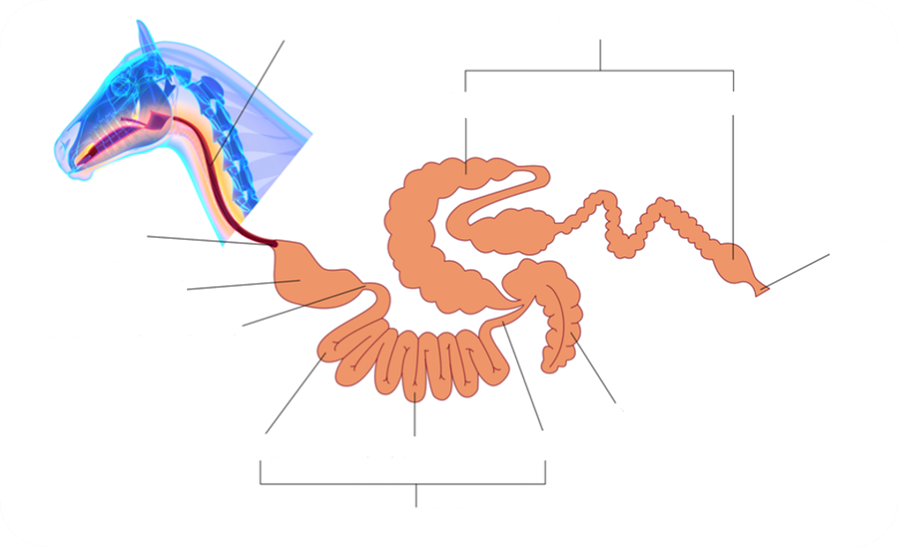
A diagram of the Equine Skeletal system.

1. Topmost Section: A short, muscular food where food enters after being swallowed, connecting the mouth to the next chamber.

2. First Large Chamber: This region is where the breakdown of food begins.

3. Muscular, sac-like organ in the digestive system that store and breaks down food.

4. Ring of muscle located at the junction of the esophagus and stomach that controls the passage of food into the stomach and prevents backflow.

5. Narrow, Looped Section: A long, coiled structure responsible for absorbing most nutrients from digested food. There are three sections. 

6. Rounded Sac-Like Structure:  Functions as a transition zone and fermentation chamber between the small and large portions of the digestive system.

7. Segmented, Pouch-like Section: This area plays a major role in breaking down material through fermentation and water absorption. 

8. Straight Section Toward Rear: Leads to the final chamber and is responsible for absorbing remaining water and compacting waste. 

Final Opening Sections: The exit pathway for waste materials, involved in excretion.


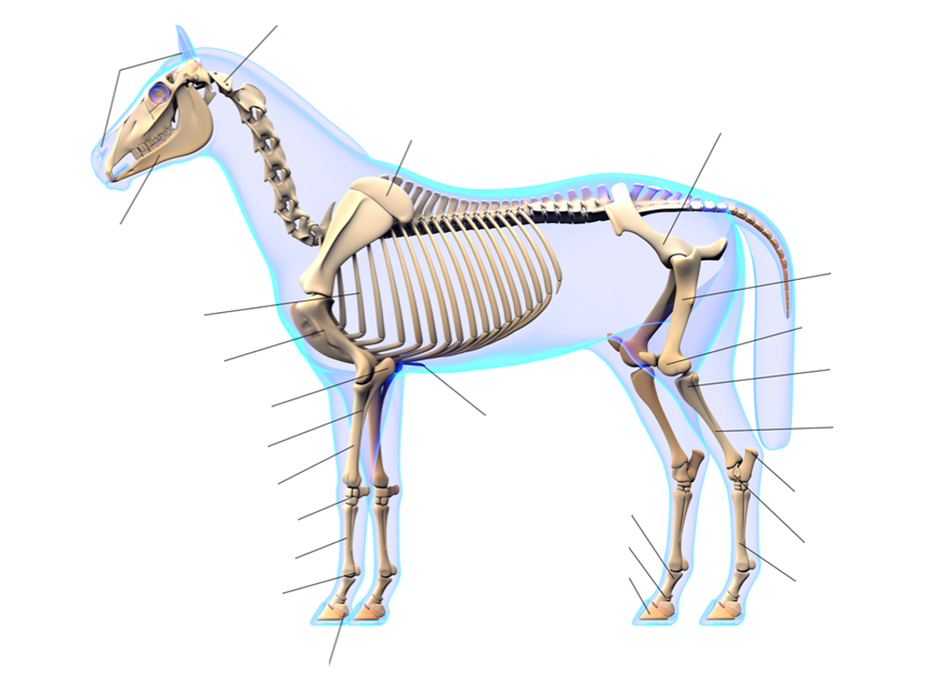
Skeletal System

A diagram of the  Equine Skeletal System. 

1. Head Bone: Forms the structure of the skull, housing the brain and sensory organs. 

2. Jaw Bone: connected to the skull. 

3. Neck Segment: Series of small, stacked bones supporting the head, C1. 

4. Cage-Like Bones: Curves bones that encase the chest cavity. 

5. Front Chest Bone: A flat bone where the ribs attach. 

6. Shoulder Blade Area: A broad, flat bone connecting the upper limb to the torso. 

7. Long bone of the upper forelimb that connects the shoulder to the elbow, supporting movement and muscle attachment. 

8. Elbow: Elbow bone, or funny bone. 

9. Middle ForeLimb Front: Long, weight-bearing bone extends from the elbow region. 

10. Middle ForeLimb Back: This thinner or partially fused bone lines alongside the main forelimb bone. 

11. Cluster Bones: This cluster of small cube-shaped bones that join the forelimb and lower leg. 

12. Elongated Bones: Lies below the knee joint in the forelimb and supports the weight of the animal, connects the joint above to the bones of the lower limb and hoof. 

13. Sesame-Seed Like Bones: One located above the hoof and below, next to the hoof. 

14. Basin-Shaped Bone: Forms the foundation of the hindquarters, connecting the spine to the hind limbs and supports the weight of the body. 

15. Large Hind Leg Bone: Bone that extends from the hip to the stifle joint and serves as main support structure.

16. Knee Bone: Sits in front of the stifle joint and is a shield and aids in extension of the hind limb. 

17. Two Long Bones: These two long bones of the hund limb extend from beneath the longest bone connected to the hip and the knee  bone. 

18. Hock Bone: forms the point of the hock in the back leg. 

19. Small Bones: Complex joint in the hind limbs made of multiple small bones and functions similarly to the ankle. 

20. Cannon Bone: connects the ankles to the toes and supports body weight. 

21. Toe Segment 1 metatarsals/carpal bones and supports movement and balance. 

22. Toe Segment 2: intermediate bone found between toe segment 1 and toe segment 3. 

23. Toe Segment 3: small bone, like the tip of the finger and under toe segment 2.


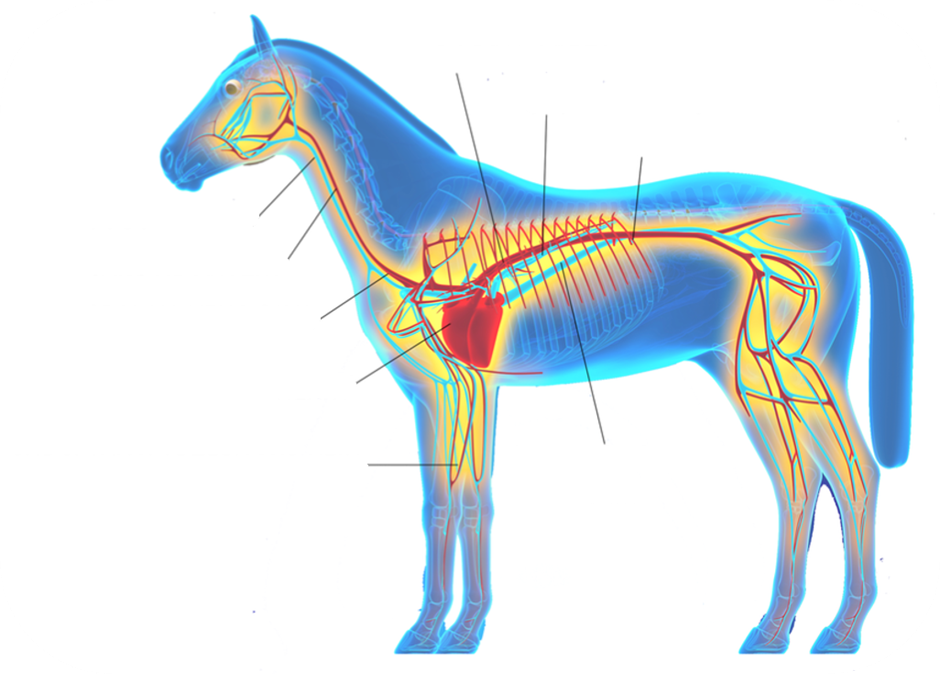
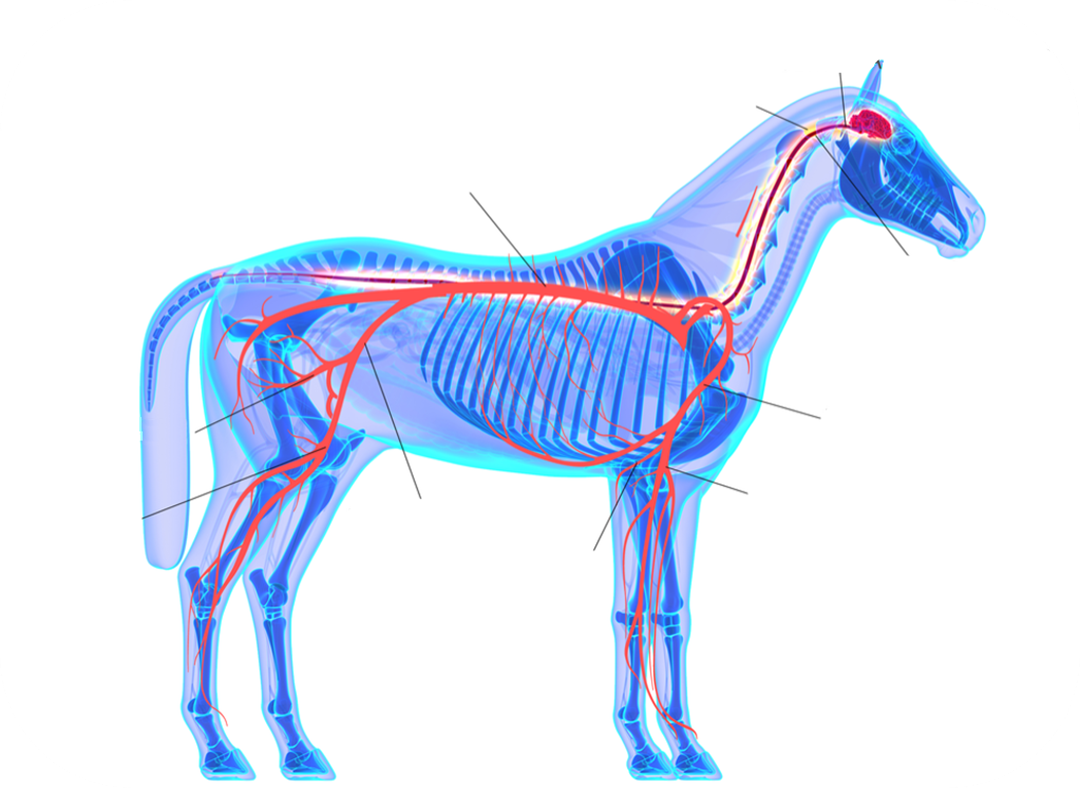
Circulatory System

A diagram of the  Equine Circulatory System. 

1. Neck Vein: Carries deoxygenated blood from the head to the back of the heart. 

2. Neck Artery: Supplies oxygen-rich blood from the heart, brain, neck, and face. 

3. Head of the Heart: Large  vein that RETURNS blood from the upper half of the body to the heart, entering the right atrium. 

4. Muscular Organ in Chest: Rhythmically contracts to pump blood throughout the body, delivering oxygen and nutrients while removing waste products. 

5. Major Blood Vessels in the Legs: Located  beneath the collarbone that transports blood between the heart and upper limbs, one carries oxygenated blood away from the heart and the other returns deoxygenated blood back. 

6. Major Artery on the back: Runs along the back of the body distributing oxygenated blood form the heart to the lower regions and organs. 

7. Large Vein stemming from the side/top of the heart: carries deoxygenated blood from the lower parts of the body like the abdomen and hind limbs, back to the hearts right atrium. 

8. Branches of the Aorta: delivers oxygen-rich blood to the stomach, intestines, and other digestive organs to support nutrient absorption and digestion.

9. Portal Vein: Carries nutrient rich blood from the GI organs and spleen to the liver.


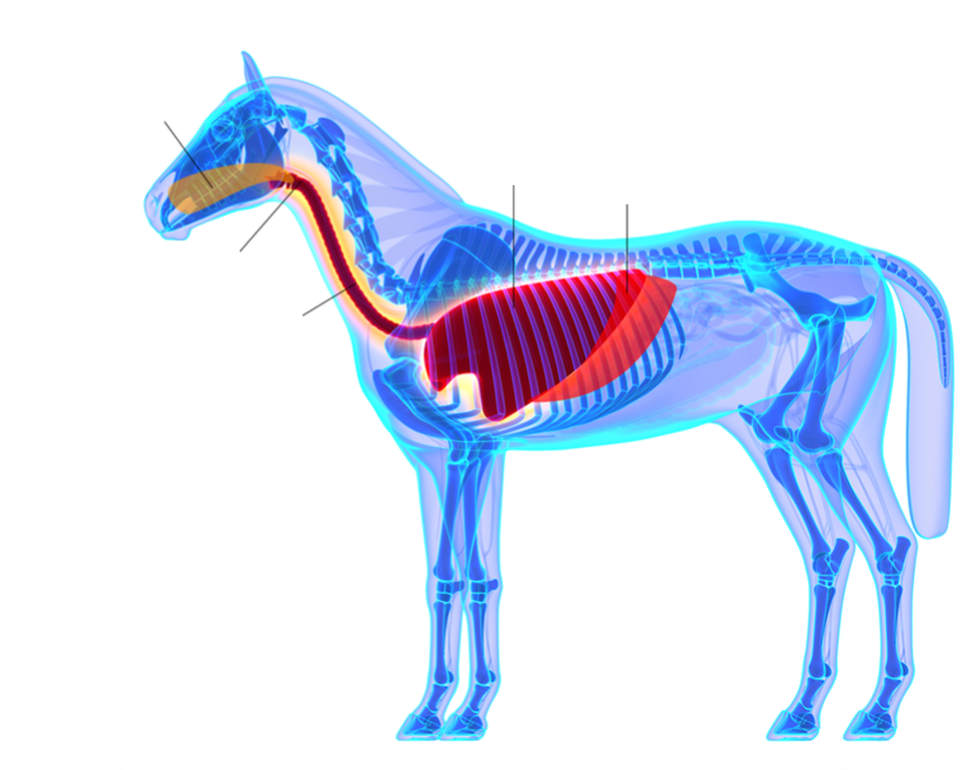
Respiratory System

A diagram of the  Equine Respiratory System. 

1. Interconnected spaces in the head: filters, warms, and humidifies inhaled air. 

2. Houses the vocal cords: functions in breathing, sound production, and protecting the airway when swallowing. 

3. Cartilaginous tube: Extends from the larynx to the bronchi, kept open by rings along this tube to the lungs. 

4. Paired, Spongy Organs: In the chest cavity where oxygen is absorbed into the bloodstream and Carbon dioxide is expelled during breathing. 

5. Dome-shaped muscle: Located beneath the lungs that contracts and flattens during inhalation to help draw air into the lungs.


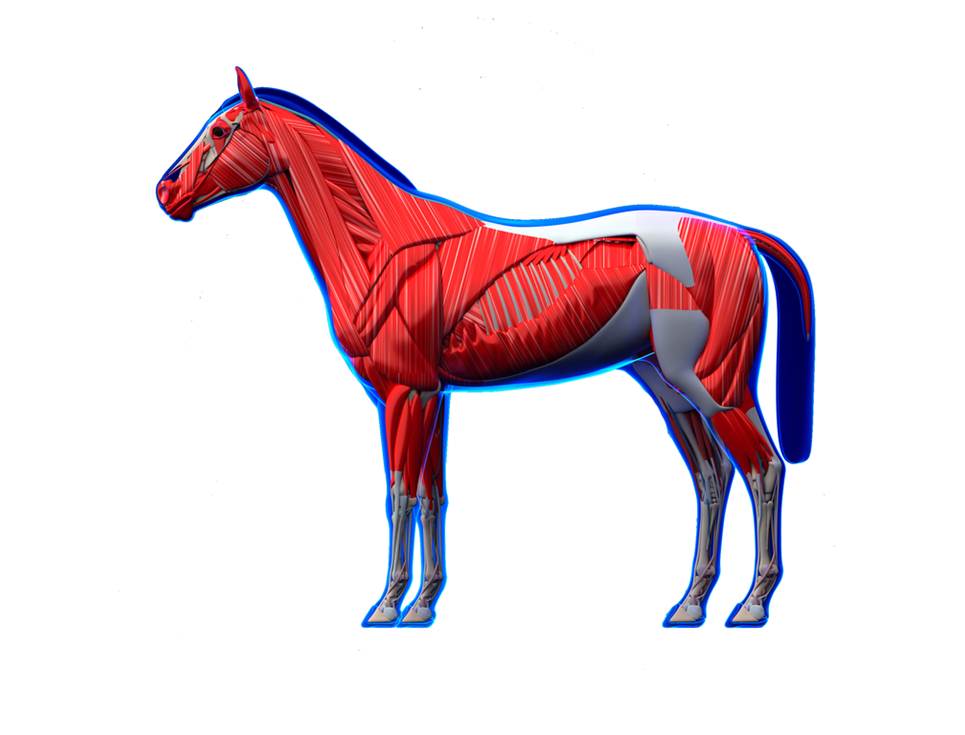
Muscular System

A diagram of the  Equine Muscular System. 

1. Muscle located in the neck region that connects the spine to the shoulder blade, helping to retract and elevate the scapula. 

2. Broad, strap-like muscle located in the back of the neck that functions to extend, rotate, and laterally flex the head and neck. 

3. Thick, rectangular muscle located in the jaw. 

4. Paired muscle that extends from the sternum to the head. 

5. Long, strap-like muscle that runs from the upper forelimb and clavicular area to the skull. 

6. Thick, triangular muscle covering the shoulder joint. 

7. Thin, superficial chest muscle located near the front of the thorax. 

8. Long muscle that runs along the front of the radius and functions to extend and stabilize the writes during forelimb movement. 

9. Forelimb muscle that runs along the front of the limb and extends digits and carpus. 

10. Small, diagonal forelimb muscle that crosses the carpus and assists in extending and stabilizing the wrist joint. 

11. Large, deep chest muscle located toward the rear of the sternum that functions to pull the limb backward. 

12. Muscles located between the ribs. 

13. Fan-shaped muscle located along the side of the thorax that helps support the trunk. 

14. Large, flat muscle extending from the neck to the shoulder and back. 

15. Large muscle on the back of the upper limb responsible for extending the elbow joint. 

16. Broad, flat muscle located on the sides of the back. 

17. Broad, flat muscle on the outer surface of the abdomen that aids in trunk rotation. 

18. Muscle located on the lateral aspect of the thigh that helps extend the stifle, flex the hip, and tense the fascia lata to support limb movement.

19. Dense sheet of connective tissue that envelops the buttocks muscles, blending with surrounding layers. 

20. Large muscle located on the back of the thigh that functions to extend the hip, stifle, and hock. 

21. Long, posterior thigh muscle that assists in extending the hip and hock. Located near/on the tendon. 

22. Slender muscle along the outer side of the limb that extends the digits. 

23. Muscle located along the front of the hindlimb that extends the digits.


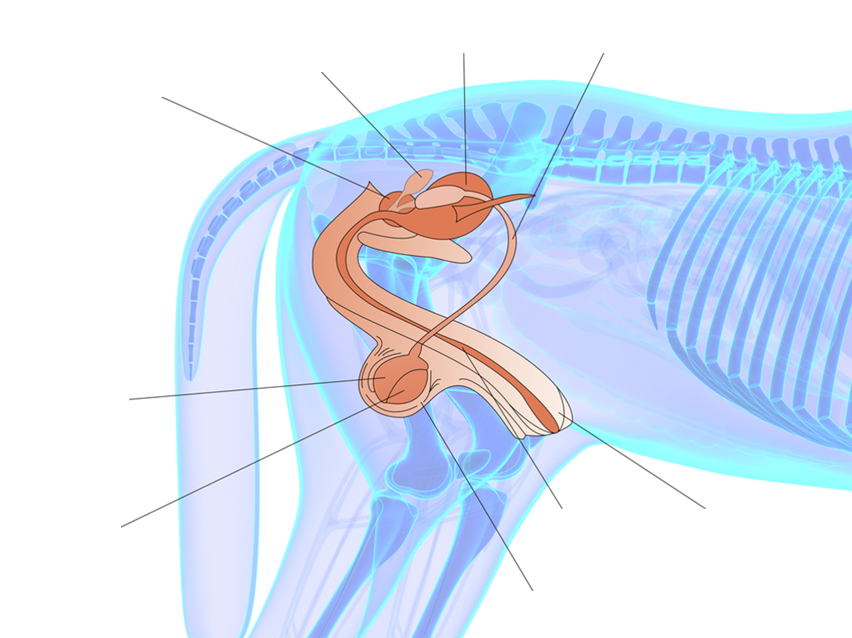
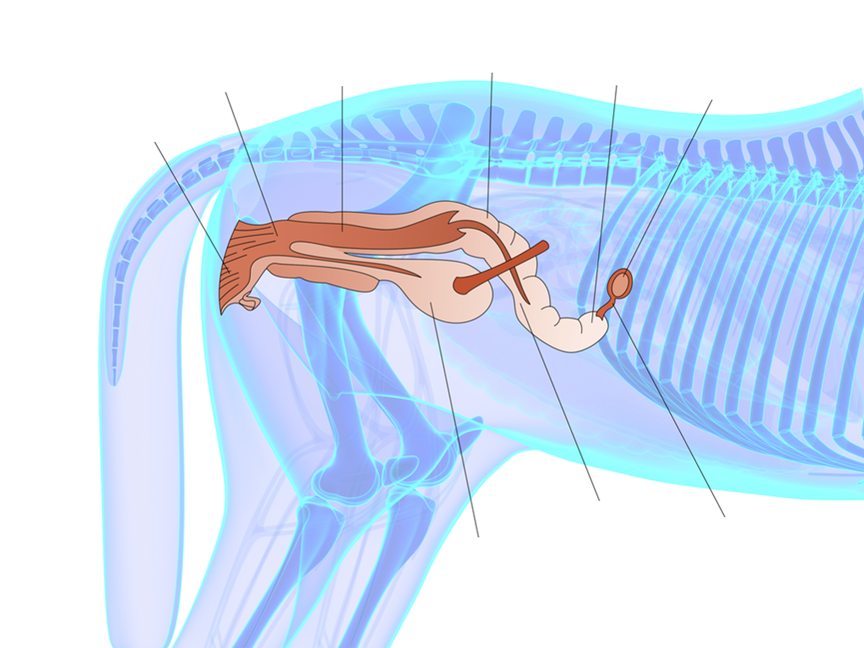
Reproductive System

A diagram of the  Equine Reproductive System, Male.

1. Small Gland located below the bladder in males that produces a fluid component of semen to nourish and protect sperm.

2. Coiled tube located on the back of the testis where sperm matures and stored before ejaculation. 

3. Male reproductive organ housed in the scrotum that produces sperm and testosterone. 

4. Accessory gland in the male reproductive system that secretes a fluid and other substances to nourish and transport sperm. 

5. Houses urine before traveling out of the body. 

6. Muscular tube that transports mature sperm from the epididymis to the urethra in preparation for ejaculation. 

7. Skin layer that encases the testicles. 

8. Tube that extends from the bladder and expels both urine and semen.

9. Sensitive, rounded tip of the penis that plays a key role in sexual stimulation and protects the end of the urethra.


A diagram of the  Equine Reproductive System, Female.

1. External part of the female genitalia that includes structures such as the labia, clitoris, and vaginal opening, serving protective and sensory functions. 

2. Space within the vulva between the labia minora that contains the openings of the urethra and vagina. 

3. Muscular, elastic canal that extends from the external genitalia to the uterus, serves as the passageway for sexual intercourse and childbirth. 

4. Lower, narrow portion of the uterus that connects to the vagina and serves as a gateway for sperm and childbirth. 

5. Paired structure, tube-like extensions at the upper corners of the uterus that connect to the oviducts and serve as site for embryo development. 

6. Female reproductive organ that produces eggs and secretes hormones such as estrogen and progesterone. 

7. Houses urine before traveling out of the body. 

8. Central, muscular portion of the uterus where a fertilized egg can implant and develop during pregnancy.

9. Slender, tubular structure that connects the ovary to the uterus and serves as the site where fertilization typically occurs.


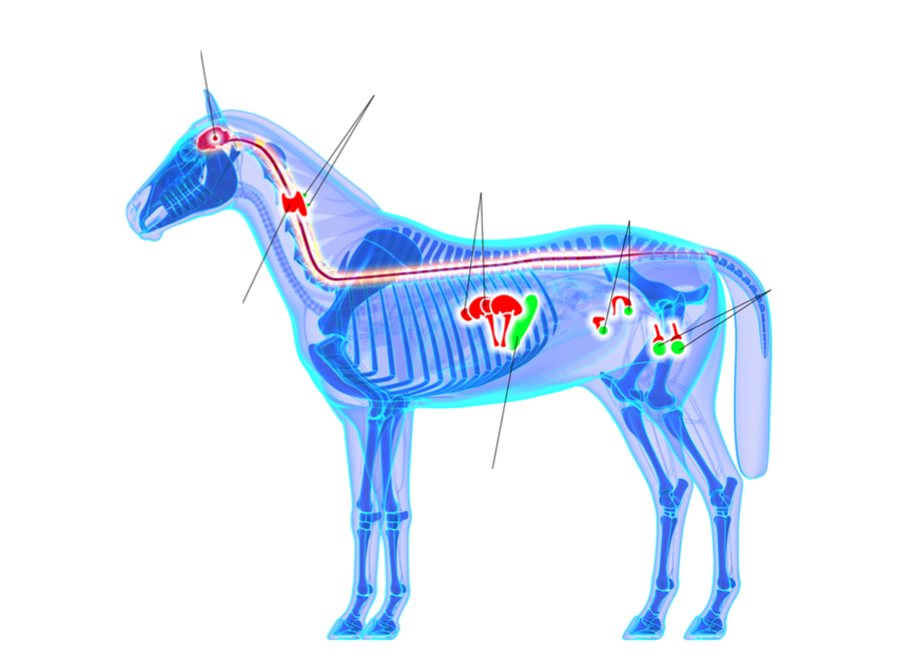
Endocrine System

A diagram of the  Equine Endocrine System. 

1. Small, pea-sized gland located at the base of the brain that regulates numerous vital body functions by releasing hormones. 

2. Gland located in the neck that produces hormones essential for regulating metabolism, growth, and development. 

3. Small glands located on the back of the thyroid that regulates calcium and phosphorus levels in blood and bones. 

4. Small, triangular-shaped glands located on top of each kidney that produces hormones involved in stress, metabolism, and bp regulation. 

5. Gland located behind the stomach that functions in both digestion by releasing enzymes and produces insulin. 

6. In females, it is a paired structure that produces eggs and secretes hormones. 

7. In males, it is located in the scrotum that produces sperm and secretes testosterone.


Immune System

A diagram of the  Equine Endocrine System. 

1. An opening in the lower abdominal wall through which structures such as the spermatic cord in males or the round ligament in females pass. 

2. Lymph node located along the iliac blood vessel that helps filter lymph fluid from the pelvis and lower limbs. 

3. Lymph node located behind the knee that filters lymph from the lower leg and foot. 

4. Lymph node located in the upper thigh near the femoral vein, responsible for filtering lymph from the lower limb and external genitalia. 

5. Lymph node beneath the lower jaw that helps filter lymph from the face, mouth, and neck regions. 

6. Lymph node located behind the pharynx that helps drain lymph from the nasal cavity, pharynx, and surrounding areas of the head and neck. 

7. Group of lymph nodes located in the armpit region that drains lymph from the upper limbs, chest, and breast areas. 

8. Lymph node located just in front of the shoulder blade and near the neck that helps filter lymph from the head, neck, and upper shoulder region. 

9. Lymph node located along the facial vein that helps drain lymph from the skin and muscles of the face.


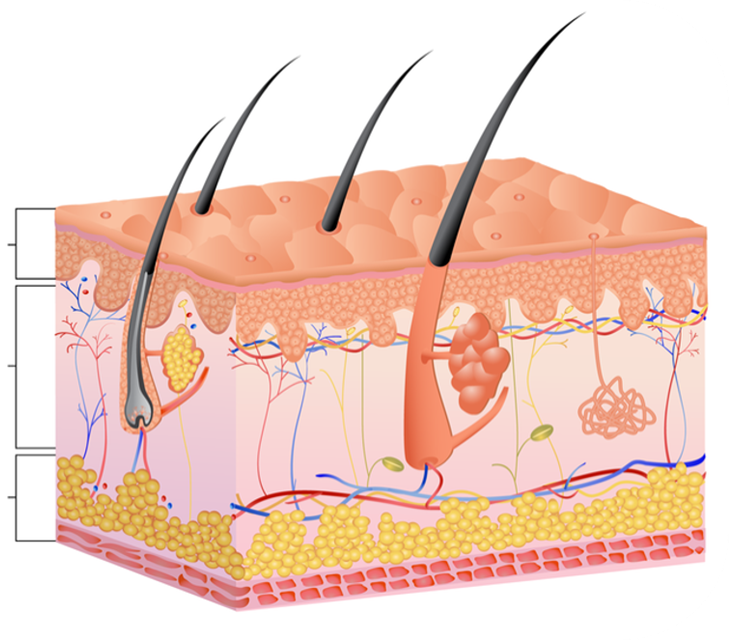
Integumentary System

A diagram of the  Equine Integumentary System. 

1. Top and outermost layer of the skin that provides a protective barrier against environmental damage. 

2. Middle layer and thick that contains blood vessels, nerves, hair follicles, and glands. 

3. Bottom and deepest layer of the skin composed of fat and connective tissue that insulates the body and cushions internal organs.


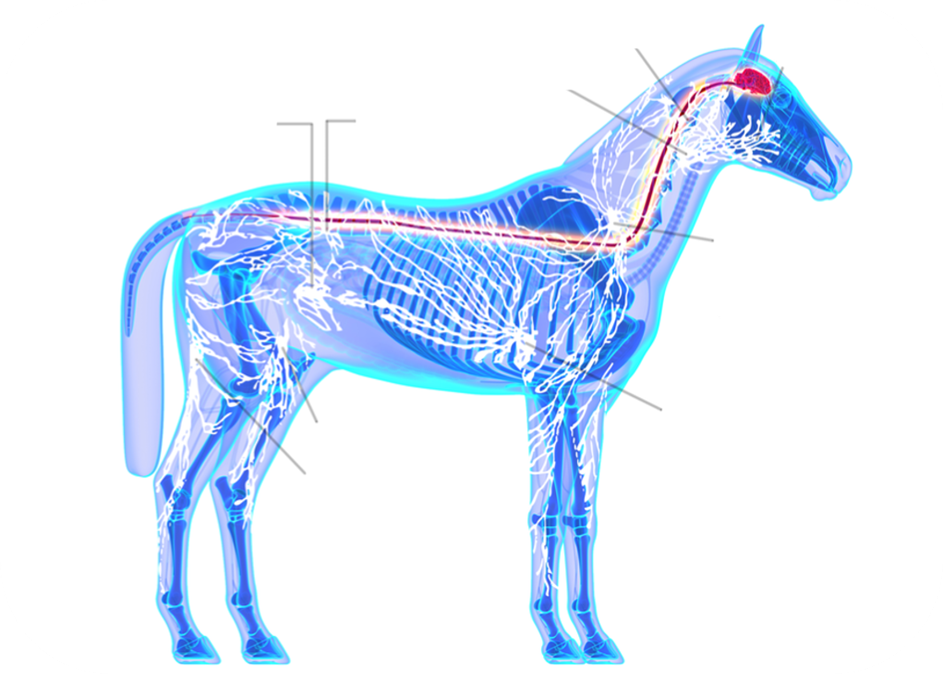
Nervous System

A diagram of the Equine Nervous System. 

1. Largest nerve in the body that runs from the lower back through the buttocks and down the leg. 

2. Nerve that is present on both the left and right side of the body. 

3. Major nerve of the thigh that originates in the lower spine and controls muscles that help straighten the leg while also providing sensation to the front of the thigh and part of the lower leg.

4. Long, cylindrical structure made of nervous tissue that runs through the vertebral column, transmitting signals between the brain and rest of the body. 

5. Nerve that runs along the inner side of the arm and elbow, supplying motor and sensory function to parts of the leg and hoof. 

6. Major nerve originating from the brachial plexus that travels down the posterior arm to power the extensor muscles and convey sensation to the back of the upper limb and hand. 

7. Nerve that runs down the center of the forelimb, providing motor and sensory intervention to parts of the forearm. 

8. Lower part of the brain that connects to the spinal cord and controls vital functions. 

9. Brain region located at the back of the skull that coordinates voluntary movements, balance, and posture. 

10. Two symmetrical halves of the brain responsible for processing sensory information, controlling motor functions, and enabling higher cognitive abilities.


iCEV Multimedia, LLC - This document is protected under copyright law.  Any unauthorized reproduction will be a violation of law and will be subject to legal action.